
OptiForValue article in Les Échos d’Ecofor (Issue No. 69)
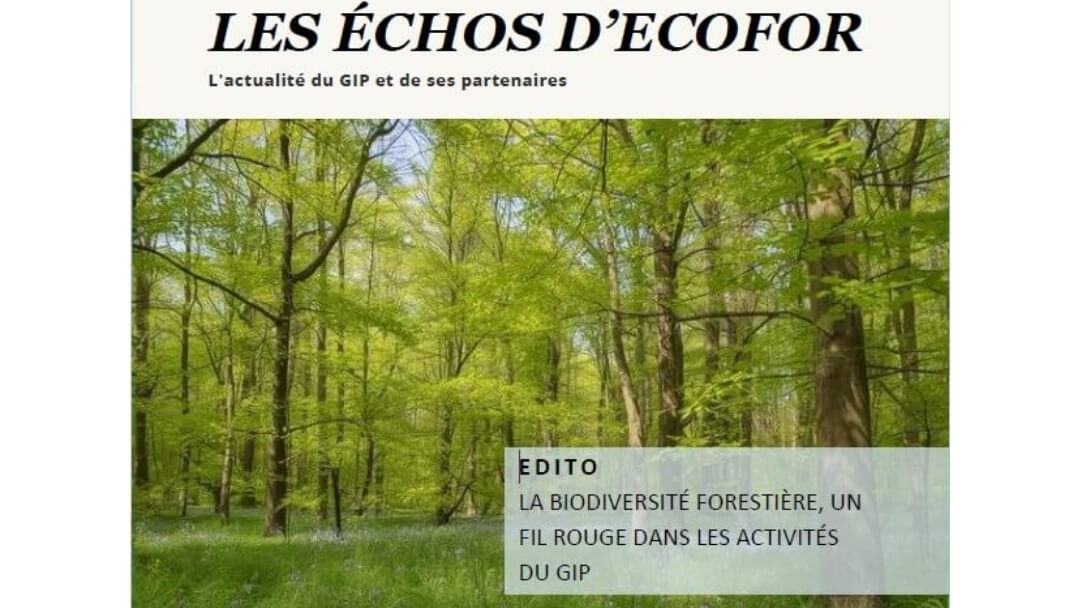
We were happy to have OptiForValue work featured in Issue No. 69 of Les Échos d’Ecofor, published by GIP Ecofor! This issue explores Forest biodiversity, a common thread in the activities of the GIP and includes contributions from:
- Nicolas Picard – Marking thirty years dedication, GIP director Nicolas Picard highlights biodiversity as the key to the proper functioning of the whole system and the vital role of scientific cooperation in times of environmental crisis.
- Summary of Jean‑Luc Peyron interview on the International Day of Forests 2026 – A conversation with the former GIP Ecofor director tracing the origins of the forest economy, the upcoming challenges in managing forest areas, and the pivotal role of organisations, like GIP in French scientific research.
- Clear‑cutting – discussed, illustrated, hyped up, or put into perspective during a roundtable of the National Assembly Commission, and then at a conference organised by the non-governmental association Canopée, Forêts vivantes.
- CBE JU OptiForValue project: progress update on the Spanish resilience case study as part of Optimising Forest Operations for Sustainable Forest Management and High-Value Applications.
- Integrating the legacy of practices and management over the long term in the assessment of forest populations: The Potential Effects Anthropisation Index (IAP) – by Vanessa Py-Saragaglia (IRAMAT-LMC, CNRS, UTBM), Sylvain Burri (TRACES, CNRS, UT2J), Céline Emberger (CEN Occitanie), Nicolas Gouix (CEN Occitanie), Laurent Larrieu (Dynafor, INRAE/CNPF), Sophie Maillé (Nature en Occitanie), Jonathan Migeot (CBNPMP), Mathys Paquereau (Master GEAD-GEMO, UT2J) and Mélanie Saulnier (GEODE, CNRS, UT2J).
- The Futurforest Project: another way to adapt forest stands to climate and health crises by Jean-Claude Tissaux
Office national des forêts – Direction territoriale Grand Est. - Computree platform – an open-source, collaborative platform (licensed under the LGPL) managed by the Research, Development, and Innovation Department of the French National Forestry Office (Office National des Forêts – ONF that processes remote sensing data through automated pipelines to extract key information for analysing and monitoring forest and natural ecosystems.
Full article in French can be found here: Les Échos d’Ecofor n°69 : Actualités et Biodiversité http://www.gip-ecofor.org/les-echos-decofor-n69/
OptiForValue article in Les Échos d’Ecofor (Issue No. 69) – English
First steps in the OptiForValue Case Study 2: Value for Resilience, Spain
Gonzalo Caballé, Issac Fernández, Raquel Martinez, Tomás Sanchez, Pablo Sabin | Cesefor, Spain; Johan Fransson, Basam Dahy | LNU – Linnéuniversitetet, Sweden; Allan Buras, Riccardo Dieni | TUM- Technischen Universität München, Germany; Olga Ormond | ERINN Innovation, Ireland
Across Europe, the OptiForValue project works to transform climate‑impacted forests through smarter management, stronger value chains, and innovative high‑value timber products that boost resilience and profitability. In Spain’s drought and fire affected Pinus pinaster forests, trials test new thinning strategies, engineered wood prototypes, and value‑chain optimisation to unlock competitive, climate‑resilient products and new economic opportunities from low‑quality or abandoned stands.
—
Applying prescriptive analytics and optimisation across four regional case studies, OptiForValue will contribute to enhanced risk management tools, adapted forest management strategies, informed silvicultural and operational restrictions, and integrated Life Cycle Assessment (LCA) to improve value‑chain resilience, sustainability, and competitiveness. A key focus is developing novel, high‑value timber products and profitable value chains that reduce impacts and benefit local communities.
In Spain’s “value from resilience” case study, a forest Decision Support System (DSS) is being developed to increase the value of wood from low‑quality stands affected by drought and bushfires in northern Iberia. The region is dominated by Pinus pinaster stands with reduced growth, diminished timber value, and declining profitability, often leading to abandonment. Engagement with forest owners, cooperatives, industry, and service providers informs scenarios and DSS design.
Case Study 2 (CS2) centres on engineered wood products that respond to climate change and support cascading use. Work includes mechanical classification for sawn timber, testing products for structural use, LCA, and logistics design for several feedstock types, including roundwood for high‑value uses.
Pinus pinaster is a major productive species in Spain, covering near one million hectares in monospecific stands and 0.6 million hectares in mixed forests. Climate change has reduced growth, raised fire risk, and lowered profitability and timber value. Current value chains rely heavily on pallet production, a low‑value short‑lived use, driving interest in higher‑value engineered products such as cross‑laminated timber (CLT) and glulam.
CS2 is sited in Castilla y León near Almazán, across a ~80‑hectare 50–70-year-old stand of mainly P. pinaster with an emerging understory of Quercus pyrenaica, Q. faginea, and Q. ilex. Stand density is highly varied, averaging ~500 trees/ha with basal areas of 25–33 m²/ha.
Four 20‑hectare scenarios were established: business-as-usual (300 trees/ha), moderate thinning (400 trees/ha), intense thinning (200 trees/ha), and a close‑to‑nature option based on Pro Silva principles. A full pre‑thinning inventory gauged wood quantity, quality, and vitality. Thinning removed 60–380 trees/ha, reducing the basal area by 16–50%. Post‑thinning inventories use permanent AFI plots and drone surveys with multispectral, LiDAR, and hyperspectral sensors. Outputs support treatment performance evaluation and new P. pinaster value‑chain solutions. Mechanical grading is progressing, with CLT, glulam, and KVH prototypes beginning next month. Key partners include Cesefor (lead), CSIC, Luke, LNU, EY Denkstatt, and ERINN.
Funding acknowledgement: The OptiForValue project is supported by the Circular Bio-based Europe Joint Undertaking (CBE JU) and its members under Grant Agreement N° 101157658. Funded by the European Union. Views and opinions expressed are however those of the author(s) only and do not necessarily reflect those of the European Union or CBE JU. Neither the European Union nor the CBE JU can be held responsible for them.
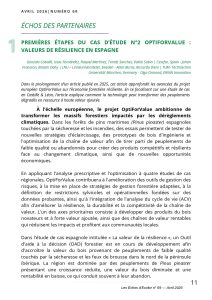
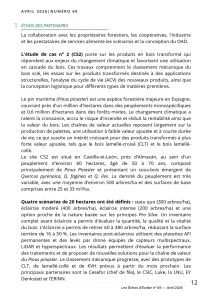
OptiForValue news article in Les Échos d’Écofor n°69